Welcome to my newsletter All Deliberate Speed where I curate and comment on the most relevant and incisive news related to educational equity. The title comes from the Brown II decision and speaks to the long delayed, but urgent and necessary work of ensuring an excellent public education for all.
Subscribe for free to join our community of informed and impatient students, researchers, educators, policymakers, and advocates.
— Raul Fernandez
NHJ DISCOURSE

She told me it was coming.
When I spoke with Nikole Hannah-Jones at SXSW EDU in March, she mentioned she was working on a follow-up to her 2016 essay about choosing a school for her daughter in a segregated city. I knew it would be personal. I didn't expect it to be so difficult to read.
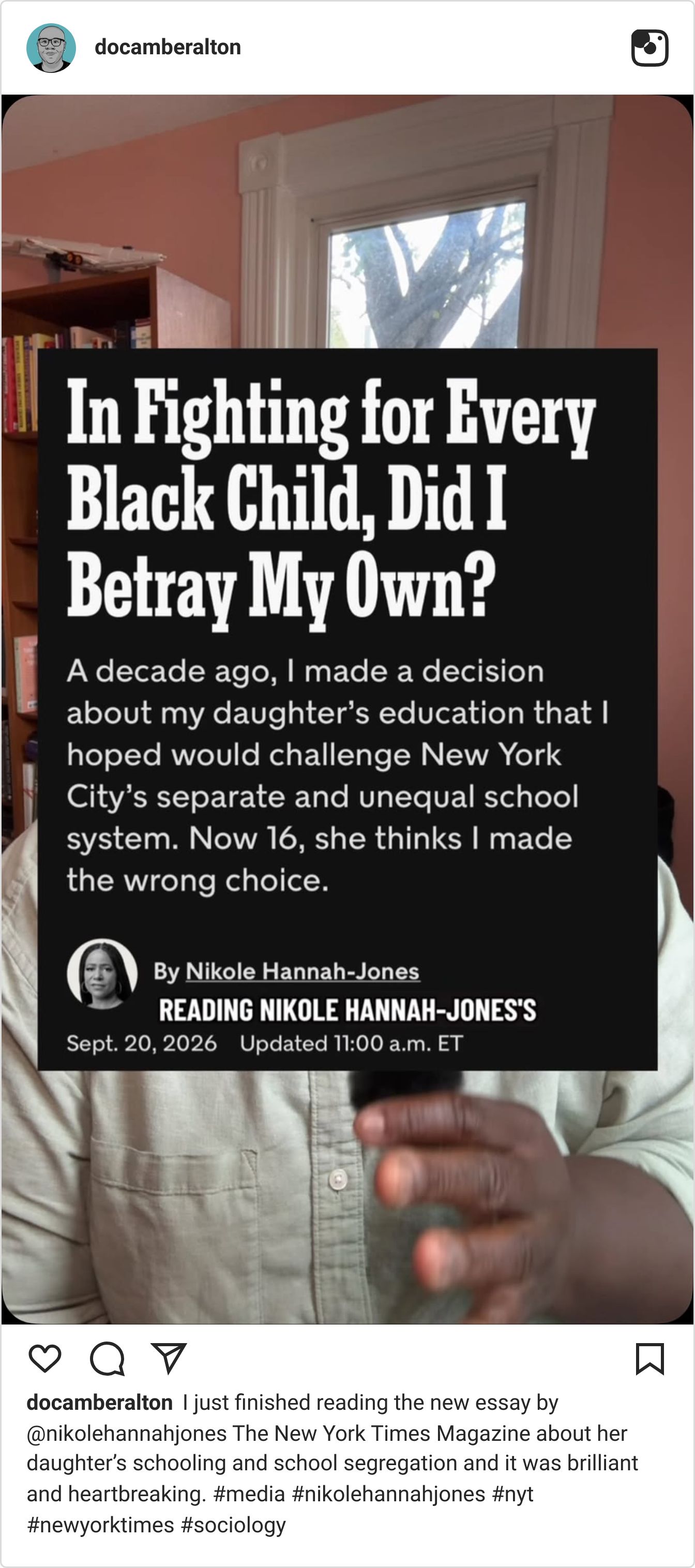
By now you must have encountered the discourse around her NYT Magazine piece "In Fighting for Every Black Child, Did I Betray My Own?" In 2016, she enrolled her daughter, Najya, in P.S. 307, a high-poverty Brooklyn elementary school, a decision she chronicled in another long-form piece, “Choosing a School for My Daughter in a Segregated City.”
Ten years later, Najya feels cheated by that choice, saying that she wishes her parents had thought more about her instead of other kids, and that she never got the education she wanted. The details are painful and, as a dad of a young girl just starting school, I cried more than once reading the story.
The reaction was immediate, loud, and mostly predictable.
Conservatives cast Hannah-Jones as a false prophet. I won’t give the worst offenders any clicks, but C. Jarrett Dieterle’s piece in Reason gives you a sense of the argument: that Hannah-Jones through her own choices had unintentionally made the case for school choice. Keri Rodrigues of the National Parents Union went further, saying Hannah-Jones owed an apology to parents who used school choice to escape low-performing schools. 🙄
More thoughtful responses came from Black parents and writers who have faced the same dilemma. In The Atlantic (paywall), Jenisha Watts, who calls Hannah-Jones a friend, wrote that she could never make the same choice and is sending her son to private preschool, with private kindergarten next.
At WBUR's Cognoscenti, Khari Thompson describes the flip side. His parents chose whiter schools in Indiana, then private school. Next was University of Chicago and Notre Dame. But as one of the few or only Black kids in those spaces, the emotional cost was high. His daughter attends the Sarah Roberts Elementary School in Boston Public Schools, where she is thriving.
So what do I think about all of this?
I talk a lot about my own child’s education in class and during public lectures, but doing so here gives me pause. Maybe it’s something about documenting her journey online without her consent, but I think it’s more than that. These choices we make for our children are deeply personal and I prefer to discuss them with my students or colleagues just so. Although, I suppose if the NYT gave me 8,000 words and a check to talk about it, I’d probably give it a go!
I’ll say this: Like many, I’m concerned that parents and policymakers will take the wrong lessons from Nikole Hannah-Jones’ story. That more families and legislators will walk away from public education. As Andrew Lefkowits of the Integrated Schools podcast said, “The concern I have is that white parents in particular will see themselves in her experience and use it as an excuse to opt out.”
Heck, even Nikole Hannah-Jones isn’t sure where to go next. As she said on This American Life, “And so what am I arguing for? I don't know anymore.” That’s heartbreaking to hear – and understandable, considering.
Listen, no parent should have to face the choices that Nikole Hannah-Jones did, and no parent should be judged for prioritizing their child over a system that would give them anything less than they deserve. But IMHO the answer is not to walk away from public education. It’s to dig in and fix what is broken.
As I argued in CommonWealth Beacon in June, that means three things:
First, unprecedented investments in urban districts – fix the buildings, pay the educators, and create more quality neighborhood-centric schools.
Second, porous district boundaries that invite students across through expanded Metco, inter-district choice, and regional magnet schools.
Finally, a housing policy focused on deconcentrating poverty. We can start by building more public and social housing in suburban communities.
This non-exhaustive list is a starting point, not an end point. Nikole’s bravery and vulnerability has created an opening to advance the cause of ensuring an excellent public education for all. Let’s not let it be for naught. Let’s dig in.
DE FACTO / DE JURE

UNDOING BROWN: The Justice Department announced Thursday that it has dismissed more than 50 desegregation cases, stretching from Waterbury, Connecticut, to Flagler County, Florida, that sat on court dockets for more than half a century. Assistant Attorney General Harmeet Dhillon called the consent decrees "onerous and outdated." By The New York Times' count, that brings the total to 57 cases dropped since Trump was reelected, and nearly 80% of them are in five Southern states.
The Legal Defense Fund called the announcement misleading. LDF points out that DOJ walking away doesn't always end the case. In Louisiana's St. Martin Parish, a court recently found intentional discrimination in student discipline. In St. James Parish, a court recently ordered the desegregation of a school that is 95% Black. LDF goes to trial in St. Mary Parish this fall.
For a clearer picture of what can happen once a decree lifts, peep DeSoto Parish, Louisiana. A federal court released the district from its desegregation order in January. That order had let students transfer out of racially isolated schools, with transportation provided. Months later, the district changed its policy and stopped accepting new transfer applications.
DISCARDING DISPARATE IMPACT: The AP's Annie Ma traced how the administration has taken apart the tools schools use to address systemic racism. This summer, the Ed Department rescinded the regulation that let schools gauge discrimination by comparing outcomes across racial groups. It then told schools that considering race when writing discipline policies is illegal, even when one group is suspended or expelled far more often.
In The American Prospect, Chris Lewis documents what that looks like on the ground. Active student civil rights investigations have been frozen, and in June the department proposed eliminating the regulations behind the Equity Assistance Centers, which for decades gave schools civil rights technical assistance. You can't fix what you refuse to measure.
AROUND MY WAY

MCAS GAPS PERSIST: In Massachusetts, this week's MCAS results brought more bad news. The share of 10th graders meeting expectations in English fell six points for the second straight year, to 45%, and the state now has 37 districts and 315 schools that need assistance or intervention, the Globe's Christopher Huffaker and John Hilliard report. Gaps by race, income, and native language remain large and barely moved.
Deputy Commissioner Robert Curtin was candid about why some gaps narrowed: higher-performing groups declined, "not because the bottom group rose." The same pattern shows up close to home. In Cambridge, overall scores improved, but the Black-white gap grew to 50 points in English and 53 in math, Cambridge Day reports. Brookline, too, continues to outscore the state while its racial gap stays essentially unchanged, according to Brookline.News. Being number one in the nation means little to the students those averages leave out.
METCO AT 60: The Globe's John Hilliard asks the right question. If Metco works, why hasn't it grown? Enrollment is roughly where it was under Jimmy Carter, and no suburb has joined in nearly half a century. The program now serves 3,200 students in 33 suburbs. Brookline, Newton, and Needham take part. Milton, Watertown, and Winchester do not.
The research shows real benefits in attendance, graduation, college-going, and earnings. The students also bear real costs, including long commutes and racism in their suburban schools. As Metco's new leader, Kandice Sumner, put it: "This practical world needs Metco." The families who sued the state in May over school segregation name expanding Metco as one remedy. If your town isn't in Metco, ask your school committee why not.
PRIVATE MONEY, PUBLIC SCHOOLS: As the Boston Public Schools lay off more than 500 teachers, a handful of its schools are flush. Five of the district's 119 schools reported more than $100 million in private donations over the past decade, and Boston Latin School claims three-quarters of it, reports Yawu Miller in the Dorchester Reporter.
The contrast is stark. In 2018, the Eliot School in the North End, where about one in five students is low-income, had $669,667. The Higginson-Lewis in Roxbury, where more than 90% of students are low-income, had $17,000. The parent group QUEST is asking BPS to track all school fundraising. Other districts pool donations. Newton, for example, runs them through a central foundation that distributes funds based on need.
TIME FOR RECESS: In a letter to the Globe, Salem State professor emeritus R. Clarke Fowler points to another gap. His 2016 survey found Massachusetts kindergartners in low-income districts got 100 fewer minutes a week of free play and recess than their peers in the wealthiest communities. A bill on Beacon Hill (S.417) would guarantee 30 minutes of daily recess for students in kindergarten through eighth grade.
Just 30 minutes? Like Kendrick said, it’s not enough.
THE RESEARCH DESK

THE HOUSING ANGLE: A new report from Johns Hopkins' 21st Century Cities Initiative concludes that school segregation in the Baltimore region is driven by regional housing segregation. Accounting for which children live within their boundaries, Baltimore City Schools are among the least segregated districts in the region. The report's conclusion is that the city schools can't fix this alone; it will take cross-boundary housing and transportation policy.
I touched upon housing policy as an approach to school segregation in my recent op-ed in Commonwealth Beacon, writing:
Part of the solution may lie outside of schools – in housing policy. Developing more public and social housing in suburban communities and the expansion of housing vouchers there would more evenly distribute low-income families and balance the distribution of high-needs students across municipalities.
TAKE ACTION

The Trump administration radically reimagined the Supreme Court's SFFA decision to go after lawful programs that support underrepresented college students. In response, way too many colleges cut programs and courses that were then – and remain – perfectly legal.
EdTrust's new advocacy toolkit is built for pushing back. It includes:
Three new guides on strengthening campus supports and improving college persistence and completion.
Ready-to-adapt testimony templates for opposing bills that defund DEI or restrict "divisive concepts.”
Power-mapping worksheets for identifying which legislators and officials can move an issue.
A dashboard of six-year graduation rates at four-year institutions.
Thanks to EdTrust for giving us these tools to fight back. But if we’re going to make progress we have to advance from defense to offense. Not unrelated, Election Day is Tuesday, Nov 3rd.
THINK ABOUT IT
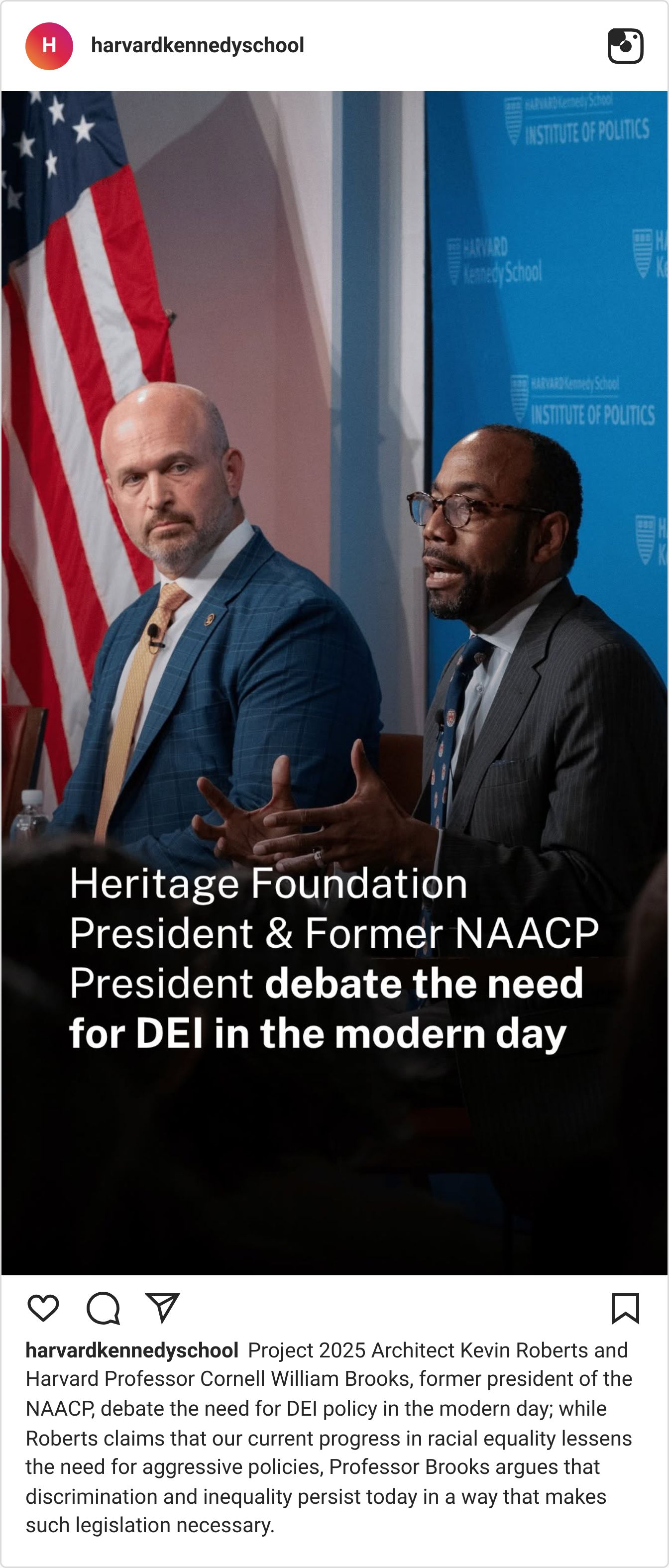
In what can only be described as some bullshit, Harvard’s Kennedy School recently hosted a debate on the need for DEI policy between former NAACP President Cornell William Brooks and Project 2025 architect Kevin Roberts.
While Brooks apparently requested to debate Roberts, debating policy (as advertised) versus debating whether anti-Black discrimination exists are two very different things. Of course, debating whether systemic racism is worthy of policy intervention with someone from a foundation called “heritage” is right on the nose for higher ed’s renewed focus on viewPOiNt dIveRsItY. 🫠
OK, ONE LAST THING
Worth your time, if you’ve got the time:
The latest 'ideological assault' on Harvard? Trump administration seeks admissions data by Michaela Towfighi, The Boston Globe.
Colleges should not be punished for trying to give every student a fair shot by Yolanda Watson Spiva, The Hechinger Report. On Treasury's proposal to strip tax-exempt status from private schools and colleges that consider race.
No One Can Fix School Segregation Alone, New York Magazine (paywall).
We Should All Be Najya Now by Christopher Stewart, a longtime integration skeptic reconsidering after reading the essay.
What Does Nikole Hannah-Jones's Mea Culpa Say About the Importance of School Choice? by Colleen Hroncich, Cato Institute. The choice movement's case.
Choosing a School for My Daughter in a Segregated City by Nikole Hannah-Jones, The New York Times Magazine (2016). Where it all started.
That’s all for now. Subscribe now to get future editions in your inbox!