“NO BAD SCHOOLS”

NYC Mayor Zohran Mamdani at the New York Knicks City Hall Ceremony. (source)
“Every school should be the right school.”
That's what New York City Mayor Zohran Mamdani told WNYC's Brian Lehrer this week. The day before, on the same show, Nikole Hannah-Jones challenged Mamdani: “When are we going to actually see a real and substantial plan to address the racial, social, and economic isolation of students?” It’s a great question, which deserves a better response.
“Every school should be the right school” is a good line. But we've heard it before.
A decade ago, Mayor Bill de Blasio promised there would be "no bad schools." Universal pre-K, a school turnaround program, and a raft of initiatives with "equity" and "excellence" in their titles would, he argued, make segregation less of a concern. Fix the schools, and it won't matter who sits in them.
Same promise and little progress to show for it over the last decade. With Mamdani in the mayor’s office and NYC Schools Chancellor Kamar Samuels at his side, will this time be any different?
What Mamdani said, and didn't
As expected, Mamdani called Hannah-Jones' essay devastating, acknowledged that the system failed her daughter, Najya, and promised a plan. But when Lehrer pressed him on middle school screens, school zones, or anything specific, he wouldn't commit.
What he offered instead was local working groups. Five of the city's 32 districts have one. The rest are expected to get one within three years.
Hannah-Jones has studied this longer than almost anyone, and she warned that working groups can become a way of studying an issue in perpetuity. She's right. New York has spent twenty years proving it.
Four mayors later
In the early aughts, Michael Bloomberg made school choice the centerpiece of his reforms and sold it as opportunity. Soon after he left office, UCLA's Civil Rights Project named New York’s schools the most segregated in the nation.
Bill de Blasio spent years refusing to say the word "segregation." His first chancellor, Carmen Fariña, told parents, "you don't need to have diversity within one building." Her alternative was "sister schools," in which affluent schools would share PTA money with poor schools and their students would become pen pals—seriously.
Then came Chancellor Richard Carranza. Unlike his boss, Mayor de Blasio, he called the system segregated and said it needed integration. He slapped a podium in front of student activists, saying, “No, we will not wait to integrate our schools, we will not wait to dismantle the segregated systems we have."
But his signature plan, to replace the specialized high school exam with seats for top students from every middle school, died in the State Legislature. A year in, Carranza struck a different tone, saying, “If I integrated the system, the next thing I'm going to do is I'm going to walk on water.”
By the start of his second year, he still had no significant integration policies of his own. De Blasio embraced his task force's recommendations without integration targets, enrollment changes, or a timeline. Carranza resigned three years into the job in the final year of de Blasio’s lame-duck administration.
Eric Adams and Chancellor David Banks went another direction. They expanded gifted and talented programs to every district and let 78 middle school programs bring back academic screens. They did it knowing what unscreening had accomplished: in its first year, low-income students' share of seats at the city's 50 most selective programs rose from 41 to 48 percent.
I am a product of NYC’s gifted and talented program and its exam schools. So I understand the individual benefit of these programs and the deep inequities that they exacerbate. Perhaps I’ll write more about this in the future.
And Mamdani?
In his first six months, just 11 of his hundreds of press releases referenced K-12 education. Mamdani campaigned on rethinking gifted and talented, and there's still no timeline. He promised to examine bias in the specialized high school exam. Now he says the test doesn't need to change.
This summer, just three Black students were offered seats in Stuyvesant's freshman class of 777. Across all eight specialized high schools, Black students received 3.5 percent of offers, though they make up 19 percent of the system.
At Bronx Science, which Mamdani and I both attended (though a decade apart), just 10 percent of offers went to Black or Latino students.
Carranza 2.0?
Which brings me to current NYC Schools Chancellor Kamar Samuels.
Like Carranza, Samuels arrived talking about integration. He calls it one of his top three priorities. Unlike Carranza, he has actually done it.
As superintendent of Brooklyn's District 13, he merged an under-enrolled, majority-Black school in Bedford-Stuyvesant with Arts & Letters, a coveted and more affluent school in Fort Greene. He moved the district away from gifted and talented programs and toward schoolwide enrichment.
In Manhattan's District 3, he pushed through more mergers, some over fierce objections, and across the two districts he brought in more than $10 million in grants for integration work. On his fourth school day as chancellor, he took Mamdani to the merged school, Arts & Letters 305 United, and called it "a model and an example for the rest of the city." Even Hannah-Jones says his record gives her some hope.
As I continue to pursue truly integrated schools, I am reflecting on a quote that was actually attributed to Dr. Martin Luther King Jr.: "I fear that I may be integrating my people into a burning house." So this is a moment that calls for action.
So why does this feel like déjà vu?
Nine months in, Samuels has released no formal integration proposals. The working groups Mamdani pointed to are Samuels' own initiative: the district-by-district approach that worked when he was the superintendent driving it. Stretched across 32 districts over three years, with no citywide goal, it starts to look a lot like Fariña's "organic" diversity.
And his instinct to defer has a track record. In District 3, he let screens return at the Anderson School's citywide gifted program because a majority of parents wanted them. This spring, he shelved plans to close or merge several small Upper West Side middle schools after parents pushed back, while conceding the problems behind them hadn't gone away. "We're going to continue to listen to parents," he told Chalkbeat in January.
Listening matters. But the parents with the loudest voices in these fights are rarely the ones whose kids are stuck in schools like Najya's.
Carranza's lesson isn't that conviction fails. It's that a chancellor's conviction needs to be matched by a mayor's commitment.
Carranza had de Blasio, who avoided the word “segregation” for most of his tenure. Samuels has Mamdani, who is more honest about the problem but won't yet commit to the policies necessary to undo it. Samuels has a better résumé than Carranza did. But City Hall hasn't changed, at least not yet.
The case for caution
The strongest argument for Mamdani's approach goes like this. Integration is a political minefield. Just ask Carranza, who was cast as a villain on national cable news and watched Albany kill his signature plan. Mamdani is spending his political capital on free childcare, which is popular and will help kids arrive at kindergarten ready to learn. Why risk it?
I understand the calculation. I've held elected office and had to weigh what should be done against what could be done. But that argument assumes integration is a fight you can't win.
Boston’s exam schools provide a counterpoint. Five years after the city overhauled admissions to its exam schools, Black enrollment at Boston Latin School has more than doubled, to nearly 16 percent. At Stuyvesant, it's 2 percent. Both are elite exam schools in big cities. The difference is political will.
The research is clear about who's responsible, too. A Stanford and USC study found that segregation in large districts has risen even as residential segregation declined, and the researchers concluded that policy choices, not demographics, are driving it. If policy made this, policy can unmake it.
That goes for Massachusetts, too, where nine students are suing the state over segregated school districts. But you wouldn’t know it even if you’re following this election cycle closely. Local folks, has anyone on your November 3 ballot said a word about it?
Hannah-Jones put it plainly: there are kids in these classrooms right now. She's asking for "enough political will to start to act on this issue seriously." For Najya, now 16, that time has nearly passed. For the kids who started kindergarten this fall, it hasn't.
Hannah-Jones isn't waiting for an answer. On October 20, she'll share a stage with Samuels at a citywide integration forum. New Yorkers, be there.
Every school should be the right school. It's on us to show up and demand a plan to make it so.
___________________________________________________
COMING SOON: CLOSER TO HOME
Speaking of demands.
Recently, Brookline for Racial Justice & Equity (full disclosure: I lead it) launched a campaign calling on the Public Schools of Brookline to take bold and urgent action on equity. In 2025, the School Committee eliminated the district's Office of Educational Equity, then voted 6–3 to reject the $188,455 our community raised to save it. Since then, the district has put forward no funding, no staff, and no plan for educational equity.
Hundreds of students, educators, and families have signed on. Not everyone is on board. One neighbor called our tone accusatory. Another suggested a more measured approach. I have responses to both. More on that soon.
In the meantime, read the demands and add your name. We deliver them to the Brookline School Committee on October 28.
SHOW UP
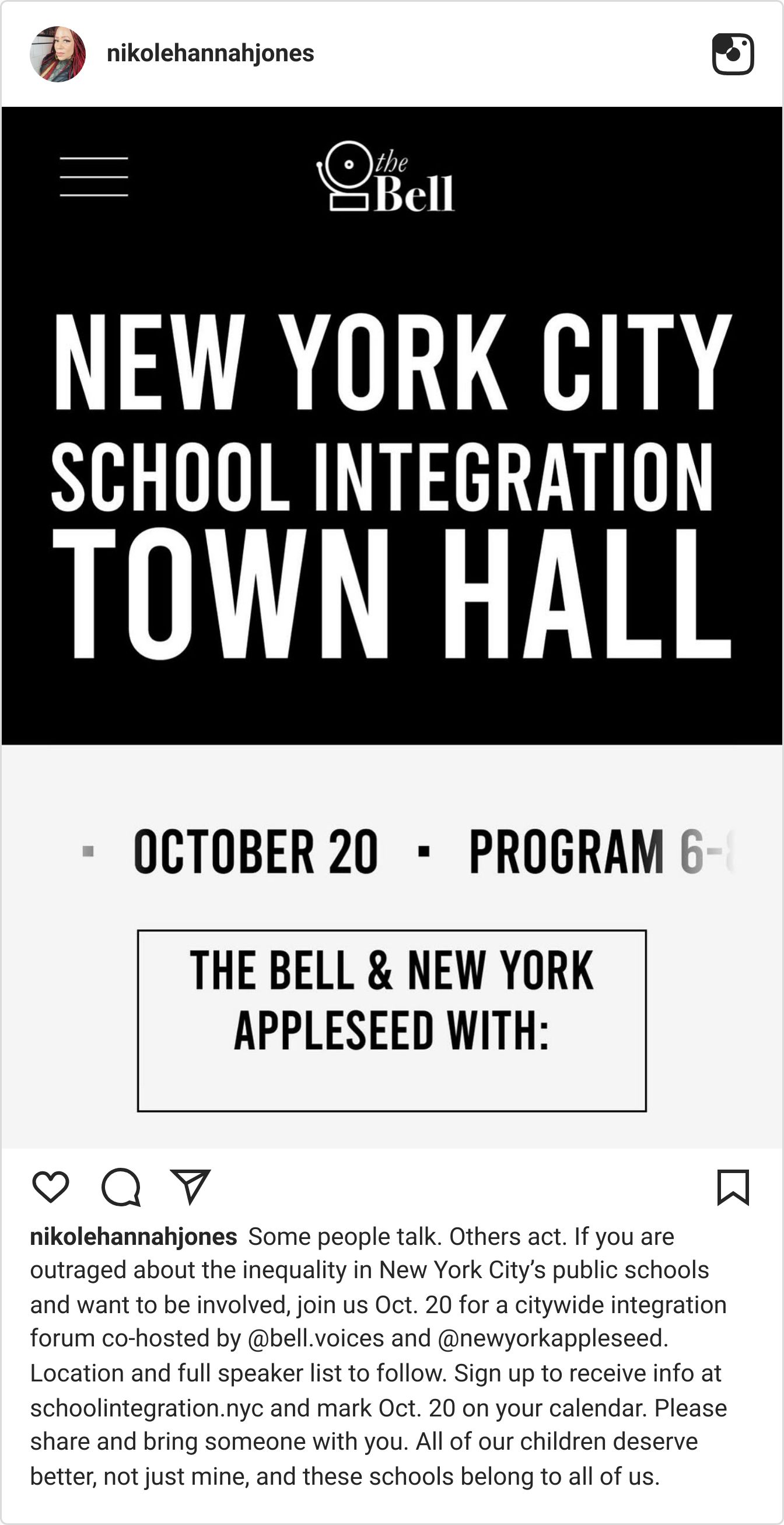
Hannah-Jones and Chancellor Kamar Samuels will appear together at "Time to Act: New York City School Integration," a citywide forum co-hosted by The Bell and New York Appleseed. Public school students, parents, and educators will also speak.
It's on October 20, with the program from 6 to 8 p.m. and a reception after. The location and full speaker list are still to come, so sign up to be notified when registration opens.
Three weeks after Hannah-Jones asked City Hall for a plan, she'll be in the same room as the chancellor charged with delivering one. Show up and ask him what it is.
LISTEN UP

TEACH / LOVE. On this week's Code Switch podcast, host Gene Demby talks with his twin sister about the different school choices they made for their kids, and with historian Noliwe Rooks about the impossible choice Black families still face 70 years after Brown: a school that will teach their children, or one that will love them.
DE FACTO / DE JURE

STILL ON THE DOCKET. Last week, the Justice Department announced it was dropping more than 50 school desegregation cases. Brown's Promise, the national school integration legal group, says that's not the whole story. In an update to supporters, legal director Andrea Hamilton Watson notes that several of those cases remain open on their court dockets, which makes DOJ's count premature at best.
And in Louisiana, the courts aren't ready to call it done. Tangipahoa Parish has one of the country's longest-running desegregation cases, filed in 1965 by Black parents who, along with their children, endured threats and violence for it. The district recently asked a federal judge to declare it "unitary" on school facilities, the last open piece of the case. That would have ended court oversight. The judge dismissed the request after two days of hearings packed with community members. A final hearing is set for early October, so the fight isn't over.
FOLLOW THE MONEY. While integration gets working groups, school choice is getting a new federal funding stream. Chalkbeat's Erica Meltzer and Melanie Asmar report that the new federal tax credit takes effect in 2027 and could become one of the largest sources of federal money for schools. Their story asks how much of it, if any, will reach public schools.
AT THE BUS STOP. Immigration enforcement near schools is back, and so are empty seats. Chalkbeat reports that at one Indianapolis school, daily attendance usually runs around 95 percent but fell below 40 percent while an ICE operation was underway nearby. DHS insists ICE isn't going to schools to make arrests.
Meanwhile, school districts in Minnesota and the National Education Association are in federal court challenging the administration's repeal of the "sensitive locations" policy.
In Connecticut, after an arrest near a Danbury school bus stop, Sen. Chris Murphy introduced bills to bar enforcement at bus stops, playgrounds, and child care facilities.
AROUND MY WAY

THE OTHER 31. Boston Latin gets the headlines, but most Boston high schoolers attend one of the city's 31 other high schools. The Globe's John Hilliard reports on a new Boston Municipal Research Bureau analysis of those schools:
They enroll nearly three-quarters of the district's high schoolers.
Nine in 10 of their students are classified by the state as "high needs."
Their enrollment is down 12 percent over the past decade, to 10,633 students.
Students there miss more school and are less likely to graduate on time.
The bureau says Boston is falling short of its own goal of giving every child the same opportunity to learn.
This is the other half of this week's lede. Boston's exam school reforms worked: Black enrollment at Latin more than doubled. But integrating three schools isn't the same as integrating a system.
THE $1.5 BILLION QUESTION. In 2019, Beacon Hill passed the Student Opportunity Act and promised roughly $1.5 billion more in school aid over seven years, with the biggest increases going to the neediest districts. Seven years later, the Globe's James Vaznis finds the results mixed.
New Bedford High School has more college-level courses and arts offerings, but MCAS scores remain stubbornly low. Poor districts still trail wealthy ones by $2,672 per student, according to the Massachusetts Taxpayers Foundation. Lawmakers are now exploring more changes to the funding formula.
THE RESEARCH DESK

RANKING THE FIXES. The New York Times' Upshot asked 37 education researchers to rate 30 ideas for fixing America's schools. Small-group tutoring and the science of reading came out on top.
School accountability, high-quality curriculum, and wider access to advanced classes gave the most for the money. Private school vouchers and smaller class sizes cost a lot for little academic gain. The experts also agreed that how well an idea is carried out matters more than which idea a district picks.
Not everyone was impressed. Retired teacher Larry Ferlazzo noted that not one of the experts was a practicing K-12 teacher.
TAKE ACTION

Senate Bill S. 5437
A bill to prohibit immigration enforcement actions at children's playgrounds.
PROTECT THE BUS STOP. Call your senators and ask them to support legislation restoring protections against immigration enforcement near schools, bus stops, and playgrounds.
ASK THEM. Before November 3, ask the candidates on your ballot one question: What will you do about school segregation? Their answers (or silence) may tell you a lot.
THINK ABOUT IT
THE BACKLASH. Hannah-Jones' essay set off a wave of criticism from the right and from school choice advocates. Some of it is worth reading, even if you disagree:
Vital City argues that Hannah-Jones and her husband exercised school choice themselves, and that her decision-making left out charter schools.
City Journal argues that bad pedagogy, not segregation, failed her daughter. It notes that P.S. 307 spent $26,372 per student when Najya was in third grade, more than the city average.
Reason argues that her own story undercuts her case against school choice.
Notice what these critiques share. Each one finds a culprit, whether pedagogy, unions, or the lack of choice, and none names segregation as part of the problem. That's worth debating, and it's exactly the debate too many elected officials are afraid of having.
OK, ONE LAST THING
Also worth your time this week:
The Lessons We're Not Learning From Nikole Hannah-Jones (The Next 30 Years)
That’s all for now. Subscribe to get future editions in your inbox!